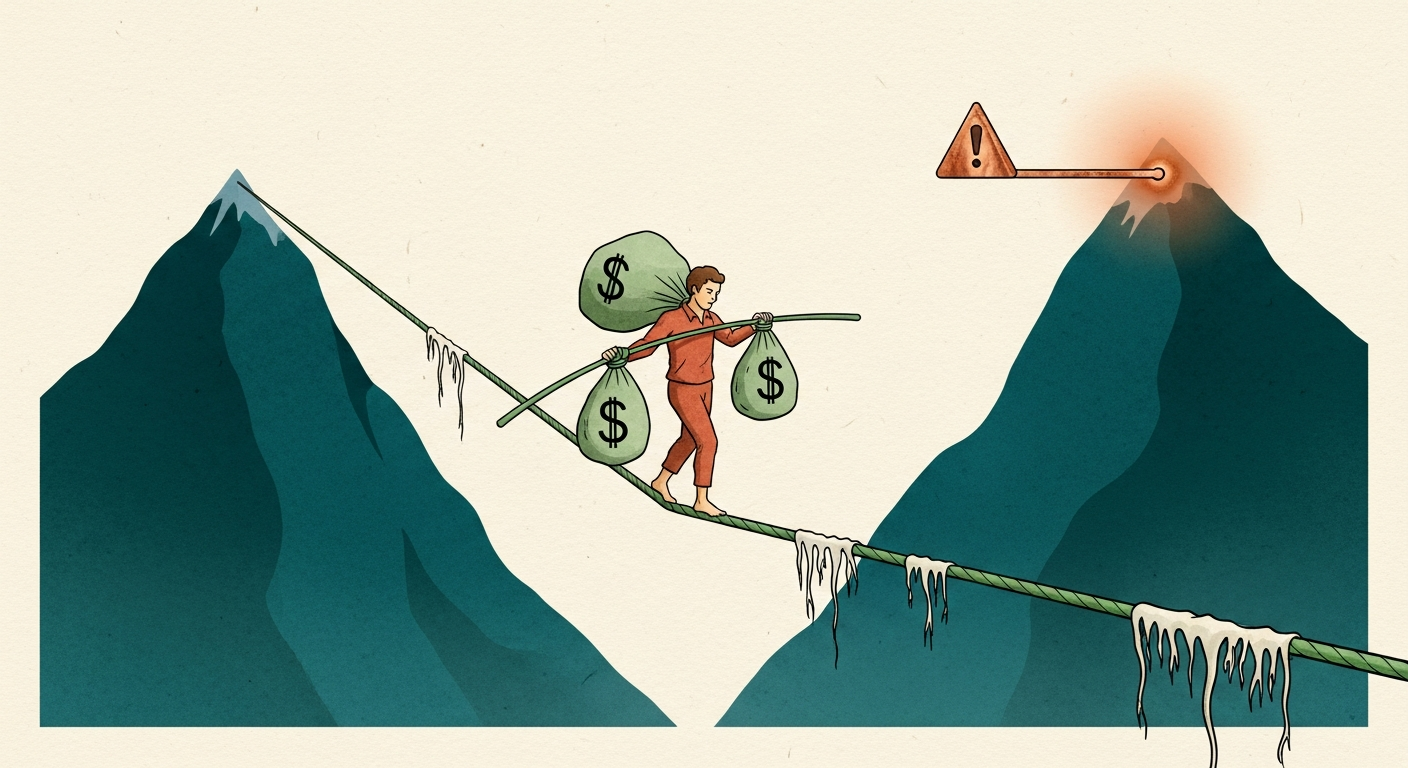
Section 01
What the carry trade actually is
A carry trade is the simplest idea in macro and it is responsible for some of the largest unwinds in financial history. You borrow in a currency where interest rates are low. You convert the proceeds. You buy something — anything — denominated in a currency where rates are higher. As long as the exchange rate stays still, you pocket the rate differential. As long as it moves your way, you also pocket the appreciation. As long as nothing surprises you, you compound. The trade is mathematically beautiful and, when nothing breaks, it works for years.
For most of the last fifteen years that low-rate currency has been the Japanese yen. The Bank of Japan held its policy rate at or below zero from January 2016 through March 2024. The Federal Reserve, meanwhile, raised its policy rate from effectively zero in March 2022 to 5.25–5.50% by July 2023. At its peak in 2024 you could borrow yen at roughly 0.1% and lend dollars at 5.3%. That is a 520-basis-point free option, before any leverage and before any directional view on USDJPY. Multiply by ten turns of leverage and the math starts to look like alchemy.
The trade does not stay on a single desk. A Tokyo bank issues yen-denominated debt because that is the cheapest funding it has. A Mexican corporate borrows in yen because the carry into pesos is even fatter than the carry into dollars. A US hedge fund finances long-Nasdaq exposure with a yen leg because it is cheaper than financing in dollars. A European pension fund overlays a yen-funded basket trade on top of its bond book to add a few extra basis points of yield. By the summer of 2024 the same trade lived under five different names on five different mandates, and almost no one held a complete map of the total notional.
That is the part most people miss when they hear the phrase. There is no single "yen carry trade" the way there is a single S&P 500 future. There is a population of related trades whose common factor is short yen exposure and whose distribution of holders crosses central banks, prime brokers, hedge funds, sovereign wealth funds, and corporates. When the funding leg moves, all of those positions reprice at the same time, regardless of what the underlying assets are doing. That is the mechanism that turns a quiet macro trade into a market-wide event.
Section 02
How the trade built — 2022 through July 2024
The setup was almost too clean. Through 2022 and 2023 the rate spread widened in a near-straight line. Every Fed hike made dollars more attractive to hold; every BoJ refusal to lift off zero made yen cheaper to borrow. USDJPY moved with the spread, from roughly 115 in early 2022 to roughly 161 by mid-2024. The yen was the weakest it had been against the dollar in thirty-eight years. Every month the trade worked, more capital piled in. CFTC speculative net positioning in JPY futures went deeply short — the largest net short on record by some weekly tallies, with the non-commercial bucket peaking near 184,000 contracts net short in July 2024.
The price action looked like a one-way escalator because, by construction, it was. The carry trade is short volatility on the funding currency. Every additional dollar of position raises the strike at which the unwind matters and lowers the threshold at which the unwind detonates. By July 2024 you could see the same setup on three different panels of the chart below: the rate-spread area chart, the USDJPY price line, and the speculative positioning bar. They were all telling you the same story. The interesting question is not whether the cliff was visible — it was — but why anyone added to the trade through June and July when the cliff was as visible as it was. The answer, as usual, is that the carry kept paying. A 5% annualized free option compounds, and a desk that walked away from it in March 2024 spent the next four months explaining underperformance to a CIO who could read the same chart.
BIS data on yen-denominated cross-border claims tells a parallel story from the other side of the trade. By the second quarter of 2024, total yen-funded credit to non-bank borrowers outside Japan had grown to a multi-decade high. The CFTC speculative book is the tip of an iceberg whose total mass is much larger and reported with much more lag, and that asymmetry is part of why the unwind moved so fast — even the participants were estimating each other's positions in real time.
Live chart
Yen carry — the build, 2022 through July 2024
Section 03
The unwind, frame by frame
Scroll through the five frames below. Each one is a real, dated event. The whole sequence ran in less than five trading days. There were no policy meetings in between, no earnings, no geopolitical shock. The trade simply ran out of marginal buyers, the funding currency caught a bid, and reflexivity did the rest.
Stage 1 of 5
Jul 31, 2024 · 03:30 UTC
BoJ surprises with a hike
The Bank of Japan lifts its policy rate from 0.10% to 0.25%. The decision is split (7–2) and the tone of the press conference signals more to come. Markets had penciled in a hold.
BoJ policy rate
0.25%
Stage 2 of 5
Aug 1 → Aug 2, 2024
Yen strengthens about 2%
Carry traders start unwinding into thin August liquidity. USDJPY drops from roughly 153 to 149 across two sessions. Speculative net short JPY positioning was the largest in years going in.
USDJPY across 2 sessions
−2%
Stage 3 of 5
Aug 2 (US close) → Aug 5 (Asia open)
Margin calls hit over the weekend
Prime brokers re-mark Friday‑night portfolios with the new yen. Funded in JPY, long Nasdaq, long Mexican peso, long anything yieldy — the same trade in five different costumes. Sunday-night calls force liquidation by Monday open.
JPY/USD, peak to trough
−12%
Stage 4 of 5
Jul 11 → Aug 5, 2024 · peak to trough
Yen rips +10% against the dollar
USDJPY traces from 161.7 on July 11 down to roughly 145 by Aug 5 — a 10%+ appreciation in the funding currency in under a month, the bulk of it in three sessions. The Nikkei 225 closes Aug 5 down 12.4%, its worst single-day percentage drop since 1987. Volatility cascades into the US session.
JPY vs USD, peak to Aug 5
+10%
Stage 5 of 5
Aug 5, 2024 · US session
Nasdaq −10% intraday
The Nasdaq 100 is down roughly 10% intraday before clawing some back. The VIX prints 65 at the open — its third-highest intraday print on record, behind only March 2020 and 2008. None of it is about earnings.
NDX intraday low
−10%
Aug 5, 2024 unwind · scroll to advance
- Jul 31, 2024 · 03:30 UTC. BoJ surprises with a hike. The Bank of Japan lifts its policy rate from 0.10% to 0.25%. The decision is split (7–2) and the tone of the press conference signals more to come. Markets had penciled in a hold. BoJ policy rate: 0.25%.
- Aug 1 → Aug 2, 2024. Yen strengthens about 2%. Carry traders start unwinding into thin August liquidity. USDJPY drops from roughly 153 to 149 across two sessions. Speculative net short JPY positioning was the largest in years going in. USDJPY across 2 sessions: −2%.
- Aug 2 (US close) → Aug 5 (Asia open). Margin calls hit over the weekend. Prime brokers re-mark Friday‑night portfolios with the new yen. Funded in JPY, long Nasdaq, long Mexican peso, long anything yieldy — the same trade in five different costumes. Sunday-night calls force liquidation by Monday open. JPY/USD, peak to trough: −12%.
- Jul 11 → Aug 5, 2024 · peak to trough. Yen rips +10% against the dollar. USDJPY traces from 161.7 on July 11 down to roughly 145 by Aug 5 — a 10%+ appreciation in the funding currency in under a month, the bulk of it in three sessions. The Nikkei 225 closes Aug 5 down 12.4%, its worst single-day percentage drop since 1987. Volatility cascades into the US session. JPY vs USD, peak to Aug 5: +10%.
- Aug 5, 2024 · US session. Nasdaq −10% intraday. The Nasdaq 100 is down roughly 10% intraday before clawing some back. The VIX prints 65 at the open — its third-highest intraday print on record, behind only March 2020 and 2008. None of it is about earnings. NDX intraday low: −10%.
“The carry trade is short volatility on the funding currency.”
Note what is not in those frames. There is no Fed meeting. There is no Treasury auction. There is no economic data release that surprised. The whole cascade was internal to the positioning. A rate-policy nudge from the BoJ — not a hike to crisis levels, just a step from 0.10% to 0.25% — shifted the marginal calculus for a trade that had grown to a size where marginal calculus was the only thing holding it together.
It is also worth being precise about what the BoJ actually did, because the FinTwit version of the story tends to inflate it. Governor Ueda raised the policy rate by fifteen basis points and signaled that future hikes were data-dependent. The decision was hawkish at the margin, not dramatically so. In any other positioning regime that announcement would have moved USDJPY by roughly a percent and faded inside a week. The reason it instead became the catalyst for a global volatility event is entirely about the size of the position that was sitting on the other side of it. The same announcement, made eighteen months earlier with a smaller speculative short on the books, would have been a non-event.
Section 04
Who actually bled
The painful answer is that nobody knows the full distribution of pain, because most of the position was over-the-counter and therefore privately reported. We know what we can see. The Nikkei 225 lost 12.4% on August 5, its worst single-day percentage decline since October 1987 — and Japanese institutional balance sheets, which are heavily weighted to domestic equities, took the first hit. We know that several large multi-strategy hedge funds reported single-day mark-to-market drawdowns in the high single digits. We know that the SPX printed an intraday low of −4.2% before recovering, and that the VIX touched 65 — its third-highest intraday print on record, behind only March 2020 and the original 2008 events.
On the funding side, anyone who had borrowed yen to finance a long anything was hit twice: once on the asset, once on the funding currency. A US hedge fund running long Nasdaq with a yen-funded leg saw both its asset fall and the dollar value of its yen liability rise by roughly twelve percent against its yen-borrowing peak. A Mexican corporate that had financed peso receivables with yen debt saw its effective borrowing cost spike before any rate decision had moved. The trade is symmetric on the way up and asymmetric on the way down, because forced unwinds happen in days while the carry that compensates you accrues over years.
The retail damage was uneven. A Robinhood user who was long QQQ on August 5 saw a bad open and a not-bad close. A futures trader running JPY shorts at the typical CFTC-tracked sizing was carried out on a stretcher. The Bank of Japan, for its part, walked back the hawkish framing within seventy-two hours — Deputy Governor Uchida went on the wires on August 7 saying the BoJ would not raise rates while markets were unstable, and the immediate cascade stopped. The trade did not return to its pre-July notional, though. The lesson stuck for at least a few quarters.
One under-discussed casualty was the funding ecosystem itself. Several Japanese trust banks that had been writing yen-denominated structured notes to overseas clients pulled back issuance in the weeks after the event, and bid-offer spreads on yen-funded swaps widened materially through August. None of that is dramatic on a chart, but it raised the operational cost of running the trade for everyone who stayed in it, and that cost stayed elevated for the rest of the year. The plumbing got more expensive even after the headline volatility had faded.
Section 05
Why this matters for the bigger debate
The August 2024 episode is the best counter-example we have to the structurally-impossible thesis covered in the companion longread on this site. The argument there goes: bank reserves are anchored inside the system, market cap is notional rather than custodial, and therefore prices cannot dislocate quickly because there is nowhere for the money to go. That argument is correct in its premises and wrong in its conclusion, and August 5 is the cleanest illustration of why.
Prices do not need money to leave the system to fall. Prices fall when the marginal buyer disappears. In a carry unwind, the marginal buyer was levered, that leverage was funded in yen, and a 12% move in the funding currency wiped out the equity stack in days. None of the bank reserves moved. The TGA balance was unchanged. Net liquidity by the standard composite barely registered the event. And yet the Nikkei lost more in one session than it had on any day since 1987.
The right way to read the structurally-impossible thesis is therefore as a statement about the floor under prices on weekly-to-quarterly timeframes, not as a statement about what can happen on any given Monday morning. The liquidity composite anchors the cycle. Positioning detonates the day. Both things matter, and they matter on different timescales. Anyone who tells you only one of them is lying to you, possibly to themselves.
There is a second implication that is worth holding onto. The August 2024 cascade was funded outside the dollar system, in a currency the Federal Reserve does not control. That is the part of the architecture that no Treasury Secretary, no Fed Chair, and no domestic regulator has direct authority over. The Bank of Japan owns that lever, and the Bank of Japan answers to a different government with different incentives on a different release calendar. The structurally-impossible argument relies, implicitly, on the assumption that the relevant levers are domestic. They are not. A meaningful share of the marginal funding for US risk assets sits on a foreign central bank’s discretion. That is true today, and it will be true at the next blow-up.
Section 06
Where the carry sits today
The chart below is the same Module 4 you saw above, advanced to today's data. The Carry Pressure Index — our composite of the rate spread and the absolute value of speculative positioning, normalized to a 0–100 band — gives you a single number to watch. It is not a forecast. It is a dashboard.
Live chart
Yen carry — live, with Carry Pressure Index
Two things are different from the July 2024 setup. First, the BoJ is no longer at zero — the policy rate sits at 0.50% as of this writing, and the bank has signaled willingness to keep going. The compression in the rate spread is doing some of the unwind for the market, gently. Second, CFTC speculative positioning has not returned to its pre-August 2024 extreme. Net JPY shorts are smaller. The trade is on, but it is on more lightly than it was.
What that means for the next blow-up is honest and unsatisfying. The conditions for a 2024-style cascade are less acute than they were a year ago. The conditions for a smaller cascade are still present. The dynamic that mattered — a crowded short in a low-volatility funding currency funding long positions in higher-yielding risk — is structural, not cyclical, and it will rebuild whenever the rate spread is wide enough to make it worth it. Watch the Carry Pressure Index above. Watch USDJPY relative to its 200-day. Watch the weekly CFTC release on Saturdays. None of those will tell you the date. All of them will tell you the regime.
A short note on what would actually flip the picture. A BoJ hike past 0.75% with hawkish forward guidance would compress the spread enough that the positioning would unwind on its own in slow motion, the way it largely has so far. A Fed cutting cycle would do the same thing from the other side. The dangerous combination is the inverse: a BoJ that pauses or backtracks, a Fed that holds, and a speculative book that rebuilds toward the 2024 extreme on the strength of carry that compounds month after month. If you see that combination — flat BoJ, flat Fed, climbing CFTC short — you are watching the next setup form in real time. The chart above is built so you can see it.
“The trade is on, more lightly. The dynamic is structural, not cyclical.”
Verdict
The 2024 unwind was real. The structure that produced it is still here, in lower size.
The carry trade did not die on August 5. It bled, retraced, and rebuilt at smaller notional. The next collapse is a question of when the spread is wide enough and the positioning is crowded enough — not whether the dynamic still exists. Watch these three numbers weekly.
Three things to watch
- 01 · DEXJPUS · dailyUSD / JPY158.10 ¥/$As of Apr 17, 2026Open chart →
- 02 · DFF − BoJ proxy ≈ 0Carry spread3.64%As of Apr 23, 2026Open chart →
- 03 · CFTC · weeklySpec JPY net—As of (not yet ingested)Open chart →