Section 01
The popular meme
There is a meme that lives in every retail trading group, every macro Twitter thread, every late-night argument about whether the bull market can ever end. It goes like this:
“If everyone tries to sell, where does the money go? It has to go somewhere. So the market can’t really crash for long.”
It is comforting. It is intuitive. It feels conservation-of-energy correct. And it is the question we get asked more than any other — usually right after someone shows their parent a chart of the Fed’s balance sheet and points out that those dollars never came back.
The popular framing is incomplete because it conflates two very different things — the stock of money inside the financial system and the flow of marginal trades that set asset prices. Both matter. Neither one alone tells you what you want to know. The meme is right about one of them and wrong about the other, and the trick is figuring out which is which.
So we built this site to answer the question with public data — every series sourced from FRED, the Treasury, the BLS, the BEA, the CFTC. No paywalled feeds. No proprietary models. Every chart on this site is a query you could write yourself if you had a free afternoon and a laptop. The point is to make it possible to argue about macro using shared evidence.
As of April 2026, here is what the data actually shows.
Section 02
The stock argument: liquidity is anchored
The first half of the meme is grounded in something real. The dollars the Fed created during the 2008 and 2020 emergencies did not evaporate. When the Fed buys a Treasury from a primary dealer, it credits the dealer’s bank with a deposit and credits its own books with a reserve. That reserve is a liability of the Fed and an asset of the bank, and it does not go away unless the Fed actively shrinks its balance sheet by letting bonds mature. The reserves are anchored on the liability side of the central bank.
Those dollars then move around the financial system. They sit inside the banking system as reserves. They sit at the Fed itself in the overnight reverse-repo facility, where money market funds park cash overnight in exchange for Treasury collateral. They sit in money-market funds. They sit in the Treasury General Account, which is the federal government’s checking account at the Fed. They sit as physical currency in circulation. The total quantity is, in fact, anchored — the Fed can change the location, not the total.
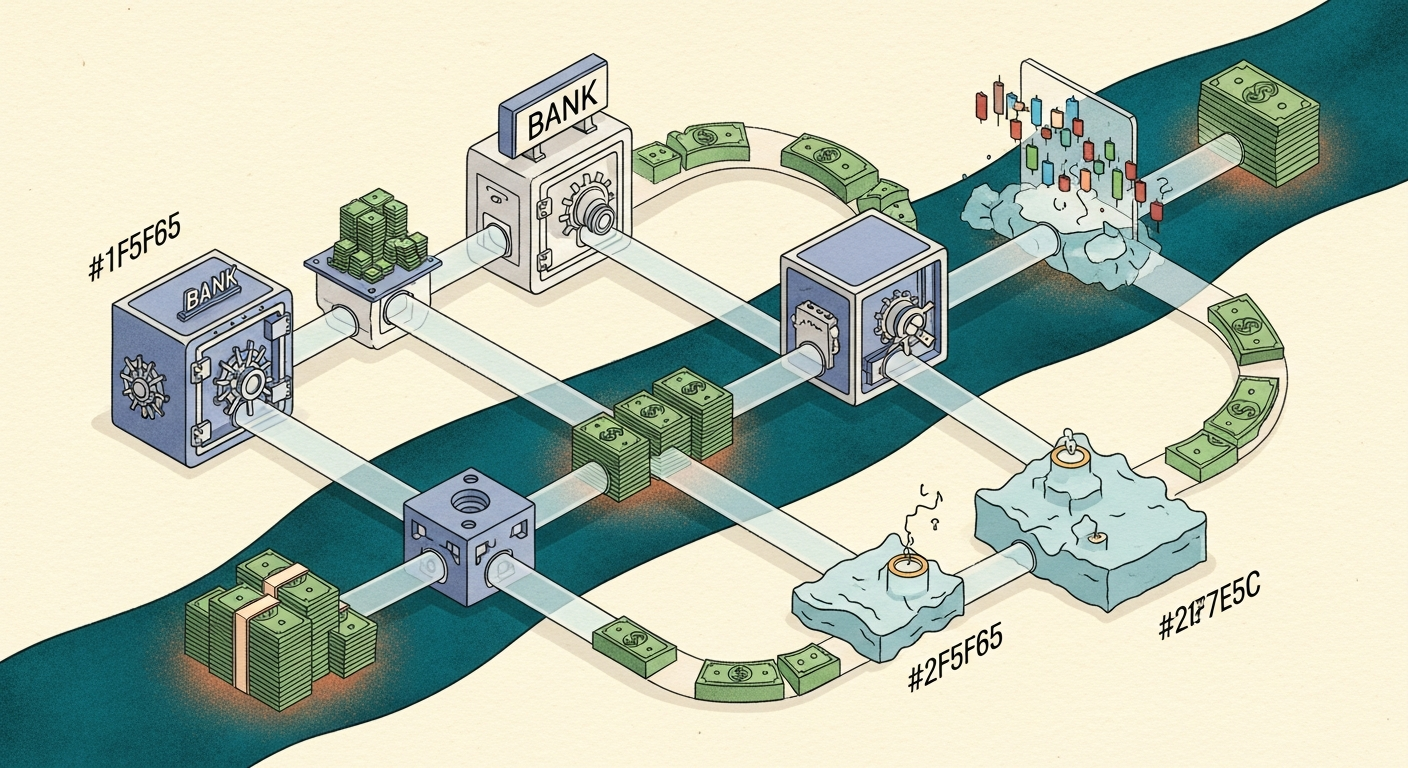
The Firehose chart traces every Fed-created dollar from 2003 to today. Notice the shapes. Bank reserves balloon during QE and grind down during QT. RRP swells in 2022 when there are no other safe yields and drains through 2024 when bills out-yield it. The TGA refills and empties on the rhythm of the Treasury’s refunding calendar — when the debt ceiling is binding, the TGA drains; when it is resolved, Treasury rebuilds it by issuing bills, which pulls cash out of the rest of the system. None of this money “leaves the system.” Two things can both be true: the stock is conserved, and the location matters enormously.
Live chart
The Firehose — where Fed-created dollars actually live
If you stop the analysis here, the meme wins. The dollars are anchored, the plumbing is closed-loop, and the worst that can happen is a sloshing of liquidity from one container to another. That would imply price level floors. It would imply that any selling has to be matched by buying at roughly current prices. It would imply that structurally a sustained collapse is impossible.
This is the version of the argument that has been doing the rounds since 2009 — that the Fed has effectively underwritten asset prices, that every dip is a buying opportunity, that the central bank cannot allow a real bear market because of the wealth effects on consumption. There is some truth in all of it. The Fed has, in fact, intervened repeatedly. Asset owners have, in fact, done extraordinarily well since 2009. The marginal dollar has, in fact, mostly chosen risk over cash for fifteen years.
Two pages in, and we have already reached the comforting conclusion. So why do markets crash?
Section 03
The flow argument: prices don’t need money to be anywhere
Because asset prices are not made of money. They are made of the last trade.
Pick any company you like. Apple has roughly fifteen billion shares outstanding. The “market cap” is just the last printed share price multiplied by that number — a notional figure, not a custodial one. Nobody actually holds three trillion dollars of Apple. There are not three trillion dollars sitting in an account labeled “AAPL.” The number is a multiplication, and the multiplier is whatever a single trade just printed at. If the last trade prints at a price ten percent lower, the wealth implied by every other share also gets re-marked ten percent lower. Nobody had to move ten percent of the market cap to make that happen. One trade did.
This is the part of the meme that breaks. You don’t need money to leave the system to mark prices lower. You need exactly one motivated seller to hit a thin bid. The notional value of the entire S&P 500 can decline by a trillion dollars in a session without a single dollar physically moving anywhere. The wealth simply re-marks.
The same mechanic runs in reverse. The 2020 March-to-August recovery added roughly twelve trillion dollars of US equity market cap. Twelve trillion dollars did not “arrive” into the stock market from anywhere. Trades happened at progressively higher prices and the multiplication updated. There was a Fed liquidity injection, yes, and that mattered for the bid; but no twelve-trillion-dollar bag of money was carried from one room to another. That is not how prices work.
“Asset prices are notional, not custodial.”
This is not a clever debating trick. It is the operating mechanic of every modern market. Liquidity is anchored. Confidence is not. The first lives in the plumbing. The second lives in the bid-offer. The plumbing operates on the timescale of months and quarters. The bid-offer operates on the timescale of seconds.
When a quant fund delevers, when a CTA flips short, when a market-maker widens a quote, when a 401(k) panic-sells at the open — the dollars on the other side of those trades do not need to be larger than the trade size. They need to be larger than the trade size at the desired price. If the available bids at the prior price are thin, the trade prints lower. The cascade follows from a positioning shock, not a liquidity shock.
Two things can both be true. The dollars never leave. The wealth can absolutely vanish.
Section 04
What August 2024 taught us
The cleanest case study of how fast confidence can break is the first week of August 2024. Borrowing yen at zero to fund dollar assets earning five percent had been the trade of the decade. Hedge funds, Japanese retail investors, sovereign wealth — every flavor of speculator had stacked into it. As of late July 2024, CFTC speculative net positioning in the yen was its most extreme short reading in a decade. Conservatively, the implied size of the global yen carry trade was several hundred billion dollars; some estimates put the gross figure above a trillion when you include all the proxies and derivatives.
Then the Bank of Japan hiked. The yen appreciated by roughly twelve percent in seventy-two hours. The forced unwinds were mechanical: as the yen rose, margin requirements on the carry trade rose, dollar assets had to be sold to raise yen to repay the borrow, the yen rose more, and the loop repeated. The Nasdaq fell roughly ten percent intraday on August 5. The VIX printed sixty-five at the open — its highest reading since March 2020 — before settling near forty. By the end of the week, equities had recovered most of the move. By the end of the month, you could barely see it on a yearly chart.
That recovery is the part that needs explaining. If the meme were perfectly correct, August 5 should not have happened in the first place. If the meme were perfectly wrong, August 5 should have kept going. Neither happened. What happened is that positioning got reset, the carry was de-risked, and the underlying liquidity environment — which had not actually changed — reasserted itself.
Live chart
Yen Carry Live — rates, price, positioning
Look at the middle panel. The August 2024 dislocation is a single spike. The yen-USD path is mostly tame for years and then breaks for three days. The bottom panel shows positioning was already at an extreme before the break. Then look at the rate-spread panel: the BoJ delivered a twenty-five-basis-point hike. Twenty-five basis points. That was the trigger. Markets had been told it was coming for weeks. Nothing about the rate move was surprising. What was surprising was how much had been built on top of the prior level.
No money left the system that week. The Fed’s balance sheet barely moved. M2 ticked up. RRP barely budged. The Firehose stock argument was completely intact. And yet wealth — real, tradable, mark-to-market wealth — evaporated in three days and re-appeared in five. Anyone who needed to sell on August 5 sold at a real loss. Anyone who held through the next two weeks barely noticed.
The August 2024 lesson is not that liquidity is fake. It is that flow and positioning can dominate stock for very dangerous windows. The dollars in the system are anchored, but the price at which trades clear is not. And in a moment where every leveraged participant is forced to delever the same trade in the same direction at the same time, the price at which trades clear can move a long way before anyone with an unleveraged balance sheet steps in.
Section 05
But there is a real liquidity floor
Here is where the meme starts to recover some ground.
Net liquidity — the Fed’s balance sheet minus the Treasury General Account minus reverse repo — is a single composite number that tracks the useful dollars at the margin. Useful in the sense that they are not parked at the Treasury, not parked at the RRP, not sitting unused. Net liquidity is what the system actually has to spend on something other than government bills and the overnight RRP rate.
It is not a magic number. It is a back-of-envelope arithmetic that approximates how much cash is genuinely available to chase risk assets. When net liquidity rises, more dollars are loose in the system. When net liquidity falls, more dollars are sitting at the central bank or the Treasury, doing nothing exciting. Empirically — and we mean empirically, not theoretically — it has been one of the more reliable explanators of S&P 500 returns over the last fifteen years.
Live chart
Net Liquidity — WALCL minus TGA minus RRP
Through most of 2023 and 2024, this metric and the S&P 500 moved together with eerie precision. Yellen’s heavy bill issuance during the debt-ceiling resolution drained the RRP into the TGA in a way that, on net, kept dollars sloshing into risk markets. The correlation was high. People with this chart on their screens made money. The Fed was technically tightening, but Treasury was effectively easing by recomposing how much short-duration paper sat outside the RRP.
But notice the breakdown periods. Late 2018, when net liquidity was rising and the S&P 500 fell twenty percent into Christmas — that was a positioning unwind in volatility-targeting strategies after October weakness, not a liquidity shortage. March 2020, when the Fed flooded the system and equities still bottomed days after the balance sheet started expanding — the bid simply was not large enough to absorb mandatory selling from leveraged risk-parity funds in real time. Most relevant: August 2024 again, where net liquidity barely moved and equities fell ten percent.
The honest read of this chart is: net liquidity is a strong baseline predictor in calm regimes, and it is useless in dislocations. Which is exactly the asymmetry we want to draw out. When markets are functioning normally, the marginal dollar finds the path of least resistance and the macro liquidity number is your best guide. When markets are dislocating, positioning and forced unwinds dominate, and the macro liquidity number tells you almost nothing about the next ten percent.
Section 06
The asymmetry
The shape of the relationship between liquidity and risk assets is not symmetric. That is the single most useful frame on this site, and it is the one that takes the longest to internalize.
When liquidity is abundant and yields are low, marginal flow goes risk-on. There is no compelling alternative for the marginal dollar. Money market funds yielding four percent are bid up. Non-zero growth assets are bid up harder. The “TINA” trade — there is no alternative — is the regime where the meme is most nearly true. In this regime, sustained collapses are genuinely difficult, because every sell-off creates a relative-value opportunity that the abundant marginal dollar will eventually take. This was 2010 to 2015. This was much of 2017. This was 2020 to 2021.
When liquidity is scarce and yields are high, that breaks down. The marginal dollar has alternatives: Treasury bills at five percent, money market funds at over four, foreign carry trades. Selling does not mechanically have to find a new asset. It can sit in cash and earn a real return for the first time in fifteen years. In this regime, the floor is much further down. The 1973–74 bear market, the 2000–2002 bear market, and the late-2018 air pocket all happened in regimes where holding cash was a viable competitor to risk. None of them were terminated by liquidity injections alone; all of them required a fundamental repricing.
What about both — abundant liquidity and high yields? That has been the 2023–2024 regime. It is unstable. The composition of the marginal dollar matters more than its absolute quantity. There are seven trillion dollars in money market funds, but a meaningful share of that is sticky retail money paid four percent to do nothing — it is not actively shopping for risk. One narrative shock — a credit event, a geopolitical hit, a yen unwind — can shift the marginal dollar’s preference fast.
What about the opposite — scarce liquidity and low yields, like Japan in the 1990s and early 2000s? That regime can produce decades of grinding sideways action without an obvious catalyst, because the comparison set has nothing attractive in it. Money does not have to go anywhere new. The wealth simply slowly does less.
This is why the question “is collapse structurally impossible?” cannot be answered with one number. The conditions matter. The composition matters. What the marginal dollar can credibly compare itself against — that is the question.
“Liquidity is anchored. Confidence isn’t.”
Section 07
Verdict — partly true, partly fallacy
So where does that leave us?
The meme is correct that the stock of dollars is anchored. We can show that. The Firehose chart shows that. Every honest macro analyst will agree on that. The reserves the Fed creates do not evaporate; they migrate. Anyone telling you that QE money has “left the system” does not understand how central bank balance sheets work, and you can stop listening.
The meme is wrong that anchored stock is enough to prevent crashes. Asset prices are notional, not custodial. The August 2024 lesson is the clean refutation. Wealth re-marks instantly when positioning gets wiped, and no amount of bank reserves sitting at the Fed prevents the print at the next trade from being ten percent lower. Anyone telling you that the Fed has “underwritten asset prices” is overstating a real but limited backstop into a guarantee, and you should also stop listening.
The interesting question is not whether collapses are structurally impossible. It is under what conditions the meme is most nearly true and under what conditions it breaks. Three conditions matter the most. They are the three you can monitor weekly with public data, free, on this site. We pin them below — net liquidity, money-market fund assets, and foreign holdings of Treasuries — and we update them on the same cadence the underlying series update. Net liquidity tells you whether the marginal dollar has cash to deploy. MMF assets tell you whether the existing cash is still happy parked. Foreign holdings tell you whether the reflexive global buyer of last resort is still showing up at auctions.
None of those three is a price target. None of them tells you what to do tomorrow. They are the gauges you watch to know which regime you are in. When all three are pointing in the same direction, you can act with relatively high confidence. When they disagree, you lower the size of any view you take and you wait for clarity.
If you want to argue with this conclusion, do it with a chart. The whole site is here for that.